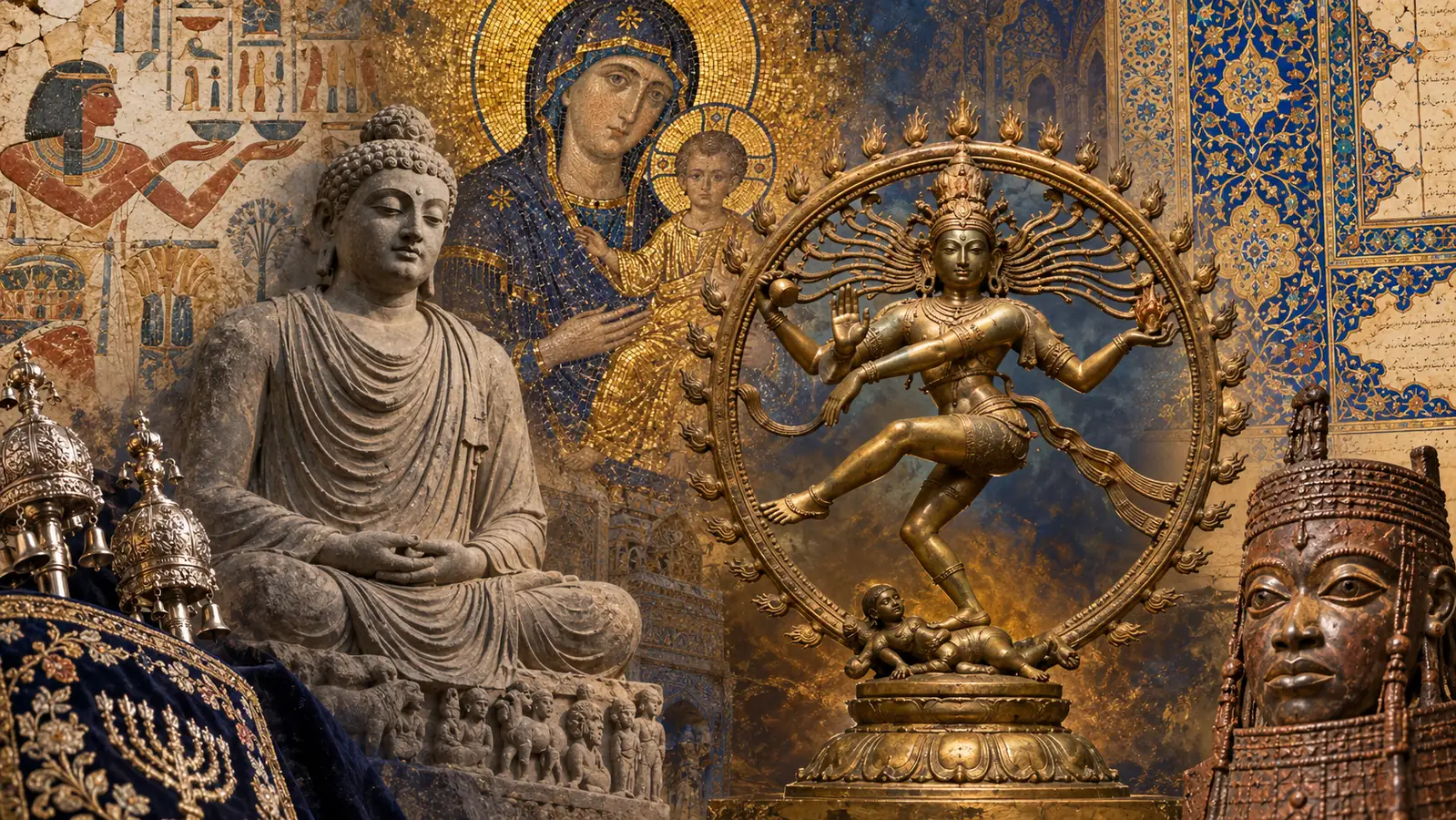
A small painted panel in a museum may once have travelled in someone’s belongings, stood beside a bed, or received a kiss before a prayer. Its surface might preserve the marks of that attention. A sculpture displayed under even lighting may once have appeared among flowers, lamps and moving crowds. Much of what we call religious art was made for encounters like these. Its history becomes easier to understand when we ask what people did with it.
Religious art has taken forms as different as a temple wall, a woven covering, a carved ancestor figure and a handwritten page. Some works tell stories. Others help organize a ceremony, preserve a memory, honour a sacred text or establish a place for worship. The category itself needs care: the distinction between religion and other areas of life has not meant the same thing in every society. Nor does every object made in a religious culture have a religious purpose.
We cannot give this history a secure starting date. Prehistoric images and objects have often been interpreted as evidence of ritual, but their purposes are not always recoverable. A surviving animal painting does not tell us, by itself, whether its maker understood it as sacred. With ancient societies that left written records, we can begin to connect particular images and buildings to documented beliefs and practices.
In ancient Egypt, a temple was understood as a residence for a deity. Within its sanctuary, a cult statue could receive food, drink and incense through rituals carried out by priests. Access to the inner rooms was restricted. During festivals, however, an image might leave the temple in a procession, bringing the deity’s presence closer to a wider public. The same statue could therefore belong to very different experiences: the controlled setting of the sanctuary and the gathering of people outside.
Images on temple walls also gave ritual a lasting form. At the Temple of Dendur, built under Roman rule, the emperor Augustus appears in the traditional role of an Egyptian pharaoh making offerings to the gods. The familiar visual language helped present a foreign ruler within an established sacred order. Religious art could sustain belief while also making a claim about who had the right to govern.
Elsewhere, artists developed quite different ways to make a sacred presence accessible. In early Buddhist reliefs in South Asia, an empty throne, footprints or a tree can mark the Buddha’s presence without showing him as a human figure. The interpretation of these scenes remains a matter of scholarship; it is too simple to assume that every absence proves a universal prohibition on images. Human representations of the Buddha emerged in the early centuries CE in centres including Gandhara and Mathura, with distinctive approaches to the body and robe.
As Buddhist communities spread, images travelled with pilgrims, teachers and patrons. Their forms changed through contact with local workshops and traditions. A sculpture made in Gandhara might show drapery informed by Mediterranean artistic conventions; a later image made in China, Thailand or Tibet would belong to another history of materials, patronage and practice. Recognizable gestures and attributes could connect these works across distance without making them interchangeable. A visitor’s route around a stupa, meanwhile, made movement itself part of devotion.
In many Hindu traditions, seeing a consecrated image is understood as an encounter in which the worshipper also receives the deity’s gaze. This is central to darshan. Offerings, bells, spoken prayers and the handling of the image can all form part of worship. To describe the sculpture only as a representation of a god leaves out the presence it holds for devotees.
South Indian bronzes of Shiva as Nataraja, the Lord of Dance, make the importance of setting especially clear. The figure’s balanced limbs and surrounding ring of flame reward close study, but certain bronzes were also made to leave the temple in procession. Cloth and flowers could cover parts of the metal surface that a museum visitor expects to see. What looks to us like an interruption of the sculptor’s design could belong to the work’s intended devotional life.
The relationship between an image and the being it represents has also provoked deep suspicion. Jewish, Christian and Muslim communities have all debated the danger of mistaking a material object for the divine. Their responses varied across places and centuries. A simple opposition between religions that make images and religions that reject them cannot explain the surviving evidence.
The third-century synagogue at Dura-Europos, in present-day Syria, is a useful example. Its assembly hall contained extensive paintings of biblical figures and events. Their survival challenges the assumption that Jewish worship always excluded the human figure. These scenes connected a local community with narratives of its past, while inscriptions recorded donors and the people involved in maintaining the building. The paintings’ exact arrangement and meanings still invite debate.
Jewish ceremonial art also developed around the care and honouring of sacred texts. The Torah scroll follows precise rules and is not illustrated. Its furnishings, however, may include embroidered coverings, silver ornaments and elaborately made containers. Beauty belongs to the act of honouring and protecting the text. The distinction between the scroll and its adornment matters: they have related but different roles.
Early Christians, living within the Roman world, used existing artistic forms to express developing beliefs. Paintings in burial spaces and images on sarcophagi included biblical episodes, praying figures and Christ as the Good Shepherd. Over time, churches offered larger settings for images, ceremonies and gathered communities. In a church interior, a figure’s position could matter as much as its individual appearance: an image above the congregation participated in an arrangement of architecture, movement and worship.
In Byzantine Christianity, icons became a focus of prayer and devotion. They could be painted on panels, worked in ivory or metal, or formed in mosaic. Some were small enough to wear; others belonged to church interiors or were carried publicly. Their defenders distinguished the material image from the sacred person honoured through it. Opponents worried that devotion was being directed towards the object itself.
These disagreements became matters of imperial policy during the Byzantine iconoclastic controversies of the eighth and ninth centuries. Images were removed, covered or destroyed in some places, and their use was restored in 843. The dispute shaped later image-making as well as what survived from earlier periods. Destruction is therefore part of the history of religious art, alongside creation and preservation.
In Islamic religious settings, the written word acquired exceptional visual importance. The Qur’an’s transmission in Arabic encouraged remarkable developments in calligraphy. A manuscript’s scale, spacing and script could give its words a particular rhythm on the page; inscriptions also entered architecture and objects. Recitation supplied an experience that the written surface alone cannot recover.
Geometry and vegetal ornament offered further possibilities for organizing sacred spaces. These traditions developed through deliberate artistic choices and sophisticated work with materials. Nor should the frequent avoidance of human figures in mosque decoration be extended into a claim that Islamic cultures never produced figural images. Painting and other media preserve abundant evidence to the contrary.
Looking beyond these traditions widens the questions we ask. Among Kota communities in what are now Gabon and the Republic of Congo, sculptures formed part of reliquary ensembles associated with influential ancestors. Figures attached to containers or bundles helped mediate relationships between living families and the ancestral realm. Their metal surfaces were cared for and kept bright; the materials and their luminosity carried meaning. Separated from the ensemble, a figure can still command attention, but part of its function becomes harder to see.
Across these examples, religious art often asks the body to participate. Someone walks around a monument, opens a book, carries a figure, lights a lamp or kneels. This helps explain why photographs can be both useful and incomplete. They show a surface while leaving out duration, restricted access, sound, smell and the knowledge a worshipper brings.
In sixteenth-century Europe, the Protestant Reformation changed the place of images in Christian life. Reformers disagreed about their acceptability and use. In some communities, religious sculptures and paintings were removed or destroyed; elsewhere, biblical imagery continued in forms considered compatible with reformed teaching. Prints also helped spread religious arguments. An image could become the subject of a dispute and the means of conducting it.
Catholic authorities reaffirmed the use of sacred images, including through the Council of Trent, which met between 1545 and 1563. In the following century, artists and patrons used painting, sculpture, architecture and light to make religious narratives compelling within church interiors. The sacred Baroque developed across an expanding Catholic world, shaped by local makers and audiences as well as ecclesiastical expectations.
That expansion was bound up with colonial power. In the Americas, Christian commissions followed conquest and campaigns against Indigenous religious practices. Indigenous artists nevertheless brought established skills and materials into new work. In sixteenth-century Mexico, feather mosaic, already a highly developed art, was used to create Christian images. Their iridescent surfaces preserve evidence of artistic knowledge carried through a violent transformation of religious life. Calling the result simply European overlooks the people and techniques that made it possible.
The later movement of sacred objects into museums introduced another change. An altarpiece fragment might be admired for its carving even after losing the structure that once surrounded it. A manuscript page might be displayed separately from its book. Objects entered collections through many routes, including purchase, secularization, colonial collecting and theft. Each work requires its own history; a museum label naming a material and date cannot tell us all that happened between its original setting and its present one.
Religious art did not cease when museums and secular art markets expanded. Communities continue to commission buildings, images and ceremonial objects, while artists also revisit inherited beliefs through personal, questioning or critical work. A sacred subject may be familiar even when the artist’s relationship to it is uncertain. The history continues wherever makers and viewers negotiate what an image can mean and how it may be used.
We do not have to share a work’s religious commitments to learn about its life. But we do need to recognize that someone else’s encounter with it may differ substantially from our own. A worn patch on a painted face, an attachment for carrying a bronze, or a fold in an embroidered covering can tell us where to begin. These small details bring people back into the history: the hands that made the object, and the hands that returned to it.
Further reading: The Metropolitan Museum of Art: Icons and Iconoclasm in Byzantium.