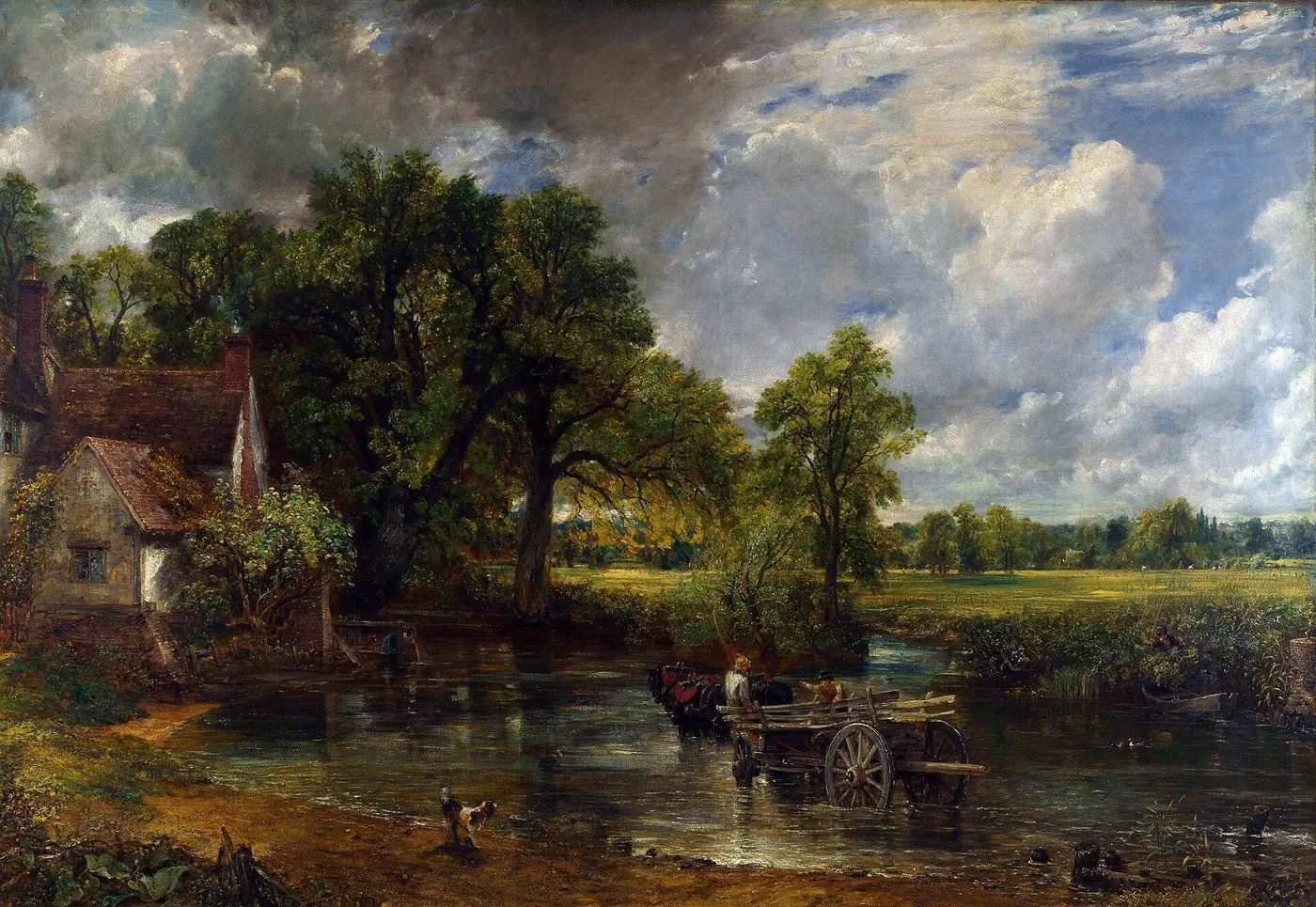
Artwork: John Constable, The Hay Wain (exhibited as Landscape: Noon), 1821. Oil on canvas, 130.2 × 185.4 cm (51¼ × 73 in.). The National Gallery, London, NG1207. Presented by Henry Vaughan in 1886. National Gallery, London.
The wagon that gives The Hay Wain its name is empty. Three horses draw it through shallow water towards a field where the hay is being cut and loaded. The journey is only a short one, yet Constable gives it the centre of a canvas nearly six feet wide. A dog watches from the bank. Across the water, a woman bends beside a house. Work continues in the distant meadow, small enough that you might miss it until you know where to look.
Constable exhibited the painting at the Royal Academy in 1821 under the title Landscape: Noon. “The Hay Wain” was a nickname used by his friend Archdeacon John Fisher, and it eventually displaced the exhibition title. A wain is a wagon; the word now sounds as though it belongs to the old countryside that the picture seems to preserve. Yet its first title directs our attention elsewhere. This is a particular hour, with sunlight breaking across the water and a sky that could change before the wagon reaches the field.
Flatford was familiar ground
The scene is the millpond at Flatford on the River Stour, near the border of Suffolk and Essex. Constable’s family operated Flatford Mill for nearly a century. He was born about a mile away, in East Bergholt, and knew the house on the left, where tenant farmer Willy Lott lived. Both the house and the mill survive. The mill itself is almost hidden in the painting: at the far right, a sliver of red brick is all Constable gives us of the family business.
The wagon is heading for the ford that gave Flatford its name. Its front wheel has begun to turn towards the crossing. Beyond it, the harvest is under way: one worker sharpens a scythe, others pitchfork hay onto a loaded cart, and another arranges the load from above. Constable makes room for all this activity without letting it overwhelm the place. The trees, dark pond, house, and open field each have their own pace.
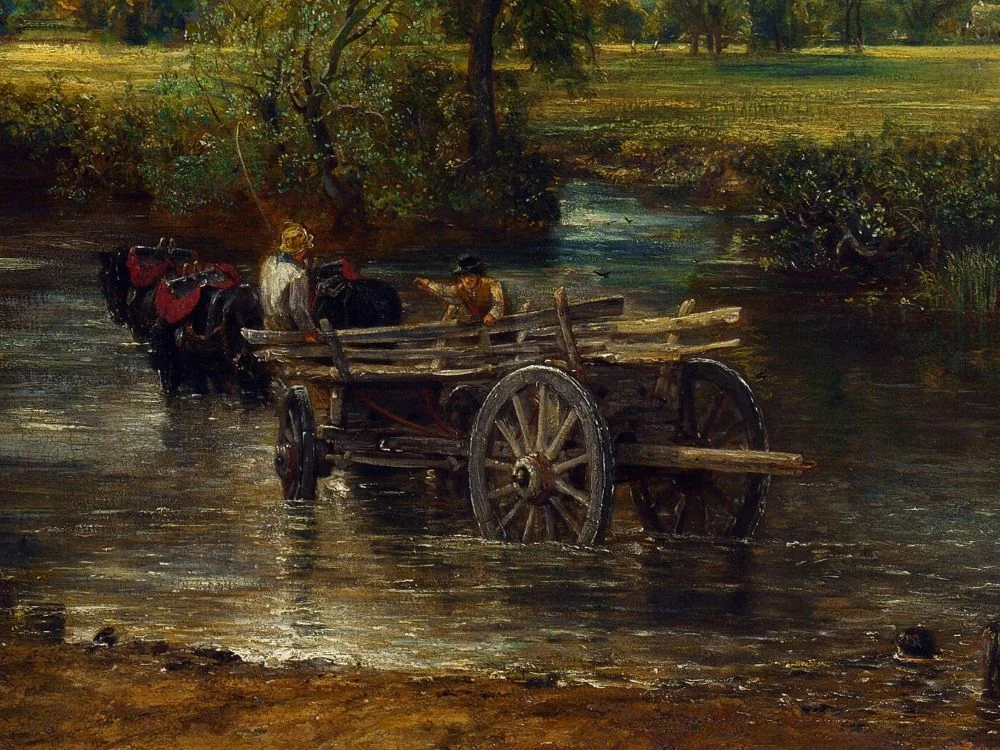
The details also resist the idea of an anonymous rural scene. The woman beside Lott’s house had appeared in Constable’s earlier studies. The little boat at the right came from a study made years before this painting. These are elements he had observed around the Stour and returned to repeatedly. He knew what could be seen from this part of the river, though he did not simply copy one view on one afternoon.

The painting made in London
For all its open-air freshness, The Hay Wain was painted in Constable’s London studio. He drew on sketches made outdoors over many years, including studies of Willy Lott’s house from 1811, and worked through the arrangement in a full-size oil sketch now at the Victoria and Albert Museum. The finished painting belongs to his series of large Stour landscapes, known as the “six-footers.” It was the third of these works exhibited at the Royal Academy between 1819 and 1825.
In the full-size sketch, a horse and rider stood in the foreground. Constable carried them into an early state of the final canvas, then painted them out. Technical examination has revealed another change: a barrel in the water was also removed. The apparent ease of the finished view took considerable adjustment. Removing the rider left the dog more alone on the bank and gave the wagon room to become the main event.
At this scale, that choice mattered. A working cart crossing a millpond was hardly a grand historical subject. Landscape painting ranked below history painting in the academic hierarchy, yet Constable gave an ordinary stretch of countryside the dimensions and attention usually reserved for more elevated themes. His paint helped make the case. Small touches of white catch light on leaves and water; darker passages sit beside bright ones without being smoothed into a uniform finish. The clouds are neither a decorative canopy nor a fixed backdrop. They are part of the day’s weather.
Constable admired seventeenth-century Flemish and Dutch landscape painters, who had also found subjects in carts, waterways, and daily work. His view of Flatford has that tradition behind it, as well as the years he spent studying this one place. Even the wagon has an interesting complication: the National Gallery notes that its low sides look better suited to carrying timber than a full load of hay. The name of the painting has made it easy to overlook what the wagon actually looks like.
A peaceful scene in changing times
Today the picture often stands for an unspoiled England. Its calm is real as an effect of the painting, but it is a carefully chosen view. The people harvesting in the distance are doing hard seasonal labour. We do not learn much about their lives from their small figures. Nor do we see the machinery, factories, or new forms of transport that were changing the country around Constable. The National Gallery suggests that his wish to paint the Suffolk of his youth on such a large scale was connected to a sense that this way of life was changing.
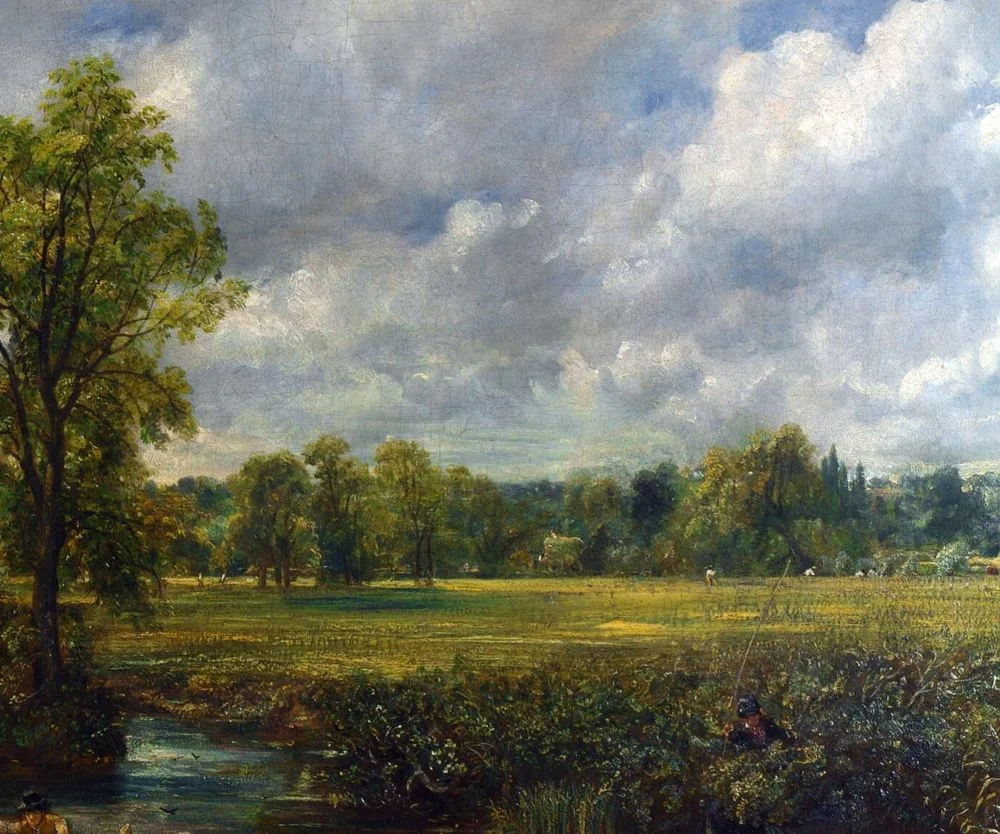
It would be unfair to ask a single landscape to record every tension of its time. It is still worth noticing what Constable chose to bring close and what he set far away. We are near enough to watch the horses enter the water and to recognise the house, but the haymakers remain across the field. This is a place he loved and knew intimately, seen through the decisions of a painter who was also making a work for public exhibition.
That exhibition brought praise but no buyer. Landscape: Noon was well received at the Royal Academy in 1821, yet remained unsold. In 1824 Constable sold it with two other works to the Anglo-French dealer John Arrowsmith for £250. Arrowsmith sent them to the Paris Salon, where the Suffolk landscape found a very different audience. Constable received a gold medal from King Charles X for the group of works, chiefly for The Hay Wain. French artists took notice of a painter who had given such close attention to light, weather, and a familiar stretch of land.
Henry Vaughan gave the painting to the National Gallery in 1886. It is now one of Constable’s most familiar images, reproduced so often that the ford, the house, and the wagon can seem inevitable. They were choices, made in London from years of observation. And the small people in the distant field are worth finding: they are the reason the empty wagon is crossing the water.